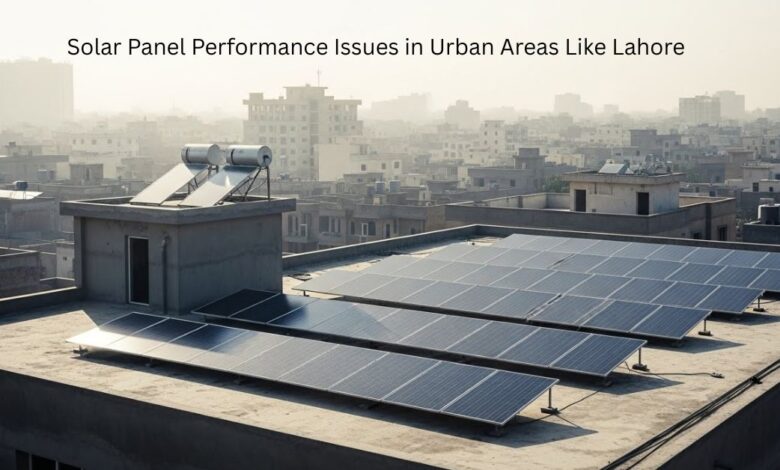
Solar energy is a promising solution to Pakistan’s persistent power shortages and rising electricity costs. Urban centers like Lahore, with abundant sunlight throughout most of the year, theoretically provide excellent conditions for solar photovoltaic (PV) systems. However, real-world performance in such dense urban areas often falls short of expectations due to a variety of environmental and structural challenges. Understanding these issues is crucial for improving the effectiveness of rooftop and urban solar installations.
1. Urban Environmental Challenges
Air Pollution and Soiling
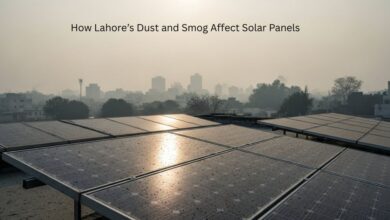
Urban pollution significantly affects solar panel performance. Cities like Lahore experience high concentrations of dust, smog, and particulate matter (PM), which settle on panel surfaces and block sunlight. Atmospheric deposits reduce the amount of solar irradiance reaching the solar cells, decreasing energy output. Studies indicate that heavy pollution can cut efficiency dramatically—sometimes by up to 30% or more in highly polluted conditions. ScienceDirect+1
- Dust and particles from traffic, construction, and industry form a layer that scatters and absorbs sunlight.
- Smog and gaseous pollutants further reduce light transmission and increase surface soiling.
Regular cleaning and maintenance are essential to mitigate these effects in urban areas. Net Meterings
2. Urban Heat Island Effect
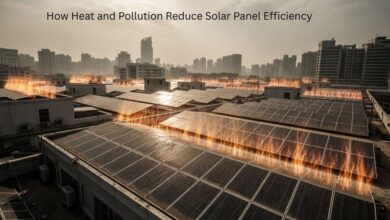
Cities tend to be significantly hotter than surrounding rural areas—a phenomenon known as the Urban Heat Island (UHI) effect. Concrete, asphalt, and urban infrastructure absorb and re-radiate heat, increasing ambient temperatures. MDPI
Unlike many electronic systems, solar panels become less efficient at higher temperatures. Their electrical performance declines as heat increases the resistance within PV cells, reducing voltage and overall power output. Francis Academic Press
In Lahore’s hot climate, where rooftop temperatures can exceed optimal operating conditions, this temperature effect is a real-world performance limiter—even when sunlight is abundant. RMC Energy
3. Shading Due to Urban Density
One of the most critical issues in urban solar performance is shading. In densely built environments:
- Nearby buildings cast shadows that vary throughout the day.
- Rooftop obstacles (AC units, water tanks, antennas) cause intermittent shading.
- Even small shaded areas can disproportionately reduce output because PV cells are typically wired in series, meaning shaded cells drag down the performance of the entire string. Francis Academic Press
Shading impacts are dynamic and complex, changing with the sun’s position seasonally and diurnally. Structural shading has been shown in research to be one of the most significant drivers of urban PV performance losses. ScienceDirect
4. Space Constraints and Installation Limitations
Unlike open rural land, space in cities is limited. Rooftops are often small or occupied by other utilities, forcing installations to be smaller, suboptimally oriented, or placed in partially shaded locations. Powerhouse Express
Innovative solutions like building-integrated photovoltaics (BIPV), solar facades, and solar carports can help, but they often come with higher costs and design complexities that many homeowners struggle to implement. solarkarachi.pk
5. Maintenance Issues and Soiling Rates
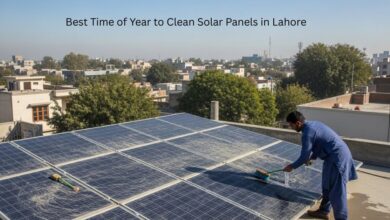
Urban solar panels require regular cleaning due to frequent dust and pollution deposition. In Lahore’s climate, dust can accumulate rapidly—sometimes reappearing just a few days after cleaning—leading to significant performance loss if neglected. Reddit
Without proper cleaning routines, energy output can drop by 20–30% or more as sunlight is physically blocked from reaching the cells. PVCARE
6. Quality of Installation and Components
Performance is not only about environmental factors. System design, component quality, and installation practices also matter:
- Poor panel orientation and tilt can result in lower solar capture.
- Sub-standard inverters can cause additional conversion losses. dsgenergy.com.pk
In urban contexts, where both space and sunlight are at a premium, optimizing every detail of the installation becomes more important than in open rural settings.
7. Weather and Climate Variability
Urban weather patterns—including cloud cover, smog, and haze—can also affect the consistency of solar irradiance. Lahore’s seasonal variations produce periods of lower sun exposure, further challenging reliable solar generation. Francis Academic Press
8. Mitigation Strategies
To improve performance in urban settings like Lahore, several strategies can be employed:
a. Strategic Site and Orientation Planning
Careful shading analysis and panel positioning can minimize losses. Tools and modeling are increasingly used to forecast shading and optimize layout. arXiv
b. Regular Cleaning and Maintenance
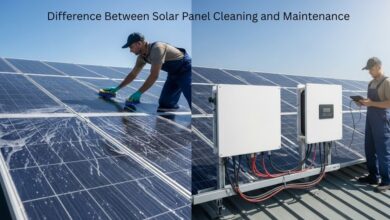
Scheduled cleaning to remove dust and particulate buildup significantly restores capacity and reduces production losses. Net Meterings
c. Use of Advanced Technologies
Integrating bypass diodes, micro-inverters, or module-level power electronics (MLPE) helps reduce the negative impact of shading by allowing panels to operate more independently. arXiv
d. Urban Planning Integration
Incorporating solar-friendly design principles into urban planning—like setback regulations, reflective surfaces, and green roofs—can improve sunlight access and reduce heat build-up. MDPI
Conclusion
While urban areas such as Lahore have high solar potential, their unique environmental and structural characteristics pose significant performance challenges for photovoltaic systems. Issues like air pollution, heat stress, shading, space constraints, and maintenance demands contribute to reduced energy production compared to ideal conditions.
However, with careful planning, informed design, and regular upkeep, the performance gap can be significantly narrowed, making solar energy a valuable and sustainable component of Lahore’s energy mix. By anticipating and addressing the specific challenges of urban environments, stakeholders can unlock more consistent and robust solar energy performance across cities.